Wednesday, May 2, 2012

Rotary Dictionaries For Kiribati

The Republic of Kiribati consists of 33 coral islands and is located in the central Pacific Ocean, halfway between Hawaii and Australia. Kiribati gained independence from Britain in 1979 and has a population  of about 100,000 people (July 2010 est.). Kiribati are generally described as Micronesian, and many speak Gilbertese, a Micronesian dialect, on the islands surrounding the capital island of Tarawa. However, English is the official language and is most commonly spoken on Tarawa and is understood in all government offices.  The schools also teach English as part of the curriculum.

Kiribati School System

Delivery of education services in Kiribati is handled as a partnership between Government and the Churches.

Education in Kiribati is free and compulsory for ages 6 to 12 years old and was introduced in legislation in 1977.  Under the legislation the government assumed responsibility for all primary schools with churches being asked to changed their focus to secondary education. The average pupil/teacher ratio in primary school system was 24 to 1 and 16 to 1 in secondary schools.

Primary education includes the first seven years: classes one to six. The 82 government-funded primary schools throughout the islands enroll about 18,000 students.  The Educational attainment in Kiribati is largely restricted to the primary level; this is principally the result of a lack of availability and cost of secondary and tertiary schools on the islands.

Secondary education (classes 7 through 11) for government school placements are competitive and based on scores from a National Entrance Examination. Less than 20 percent of primary school children receive any secondary education in government run schools. In 1997, there were 1,901 students enrolled in government secondary schools. Students who wish to continue to receive education beyond the primary level, but are unable to find placement in a secondary school, may continue for another three years in Classes 7-9.  Of the Kiribati students in secondary school, 77 percent attend church schools.  Church secondary schools  include those sponsored by: Catholic, Church of God,  LDS (Mormon), Protestant, and Seventh Day Adventists.

Kiribati has few natural resources and most families live on a day to day subsistence from fishing and gathering fruits and vegetables such as bread fruit, coconuts, Tara roots, and other native plants that grow naturally.  Some families have small garden by their homes, others work have part time employment or sell fish, hand crafted, gifts, and other homemade products along the road side.  Employment opportunities are very limited.  The nation relies very much on foreign aid from Australia, Taiwan, and other countries.

Government decentralized junior secondary schools which provide the first three years of secondary education have begun being opened.  Eventually government plans call for 24 junior secondary schools whose students will then enroll in centralized high schools.
Tertiary (post secondary) training is undertaken at the University of the South Pacific, and at a number of local institutions including Kiribati Teachers College (which trains primary school teachers), the Marine Training School and Tarawa Technical Institute. Consideration is being given to consolidating some of these institutions into a College of higher education.  Many young adults would like to attend post secondary education but the costs are prohibitive for many of them.  Those who are fortunate enough to get a job many earn about $40.00 per week.

ROTARY DICTIONARY PROJECT:

The Richfield, Utah Rotary Club sent twenty cases of dictionaries to Kiribati for us to distribute as we saw fit.   As part of the literacy program of Rotary in the USA, each year  - every 4th grader is given their own dictionary.  With thousands of children in Kiribati scattered on many different islands and atolls and with the limited number of dictionaries, we decided to try and get several schools a classroom set of 26 dictionaries.  The photos that follow are of some of the students in schools that received Richfield's Rotary Clubs generous donation.  We also thank the company that prints the dictionaries for sending them postage free to Majuro, in the Marshall Islands.  The Majuro Marshall Island Mission of the Church of Jesus Christ of Latter Day Saints then paid the freight to have them flown to Tarawa.

Moroni High School

Moroni High School celebrated its 35th anniversary since its founding this past week.  There are about 500 students enrolled from Form 1 to Form 7 (grades 7-12 age group).  Many students from outer islands and from Tarawa live in the dormitories on campus
Dictionaries being distributed by to Form 1 (7th grade age) at Moroni High School 
by Peter (their teacher) and Elder Thorne 
Moroni High Form 1 students pose with the classroom set of dictionaries in the blue and white school uniforms
The remainder of the Class display the Rotary dictionaries
We have been working with a Rotarian from Australia - Vicky Roberts to establish a Rotary Club in Tarawa.  Many of the potential members are teachers - so that helped us identify some of the schools where the dictionaries were distributed.  Some of the first cases of dictionaries were distributed to the English Department at Moroni High School for Form 1-3 students (7-9 grades).  Other schools ranged from primary, Jr. highs and high schools as shown in photos of this blog

Saint Louis High School

A  classroom set of dictionaries were presented to Saint Louis High School a Catholic School.  The two in the background standing are Elder Corwin Ogborn (a Rotarian), Kauaba Ibutuna (President of the proposed Tarawa Rotary Club and also a teacher at the school) and Elder Thorne.  Students are sitting in the maneaba at the school

Three young ladies standing in front of the Saint Louis High School sign or banner.  
Students at all the schools wear uniforms in the school colors

Dainippon Primary School

Students showing dictionaries donated to the Dainippon Primary School in Betio
Next we went to the Dainippon Primary School in Betio and presented 26 dictionaries to the principal of the school.  The school was built by the Japanese government, who occupied the atoll during the early part of the World War II.  The Battle of Tarawa took place near the site of this school.

The principal expressed her gratitude to Rotary for the donation.  Many of the government schools have very few supplies and books for students.  Some do not even have desks, so the students must sit on mats and write their lessons on the floor.  There are hundreds of potential Rotary projects through out the Nation of Kiribati.

A few students and the principal showing the rotary dictionaries presented to them

Saint Patrick College (Intermediate School)

The other school in Betio given dictionaries was a Jr. secondary school named Saint Patrick College.  Many of the Catholic churches have a parish school near vicinity.  

St. Patrick's is a junior secondary school (Form 1-3)
Catholic Church directly across the road from Saint Patrick College Junior Secondary School

Rurubao Primary School

Younger students posing with the schools  new dictionaries
Rurubao is an English speaking primary school and is considered one of the better primary schools in Tarawa
The principal and a primary teacher at Rurubao Primary School were there to receive the dictionaries


Students love to pose for pictures in front of their school banner

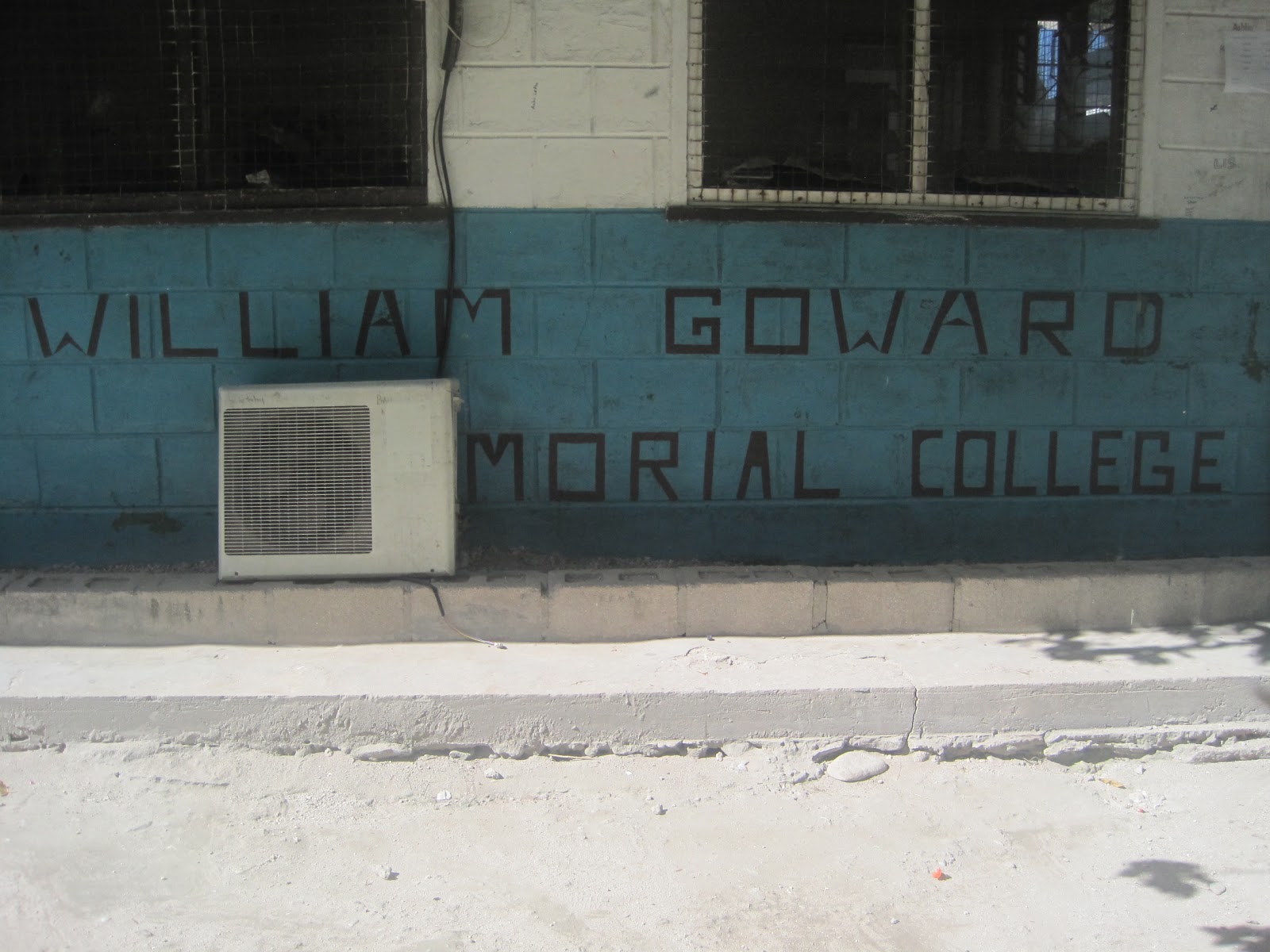
William Goward Memorial School

Students at William Goward Memorial College (a Jr. High School)  along with their principal Teretita Pwataeru.  The English Department has already begun using the dictionaries in classes
William Goward was a Protestant missionary who dedicated his life to serving the I-Kiribati people

Tinker Bell Beginner Pre-School

Students at Tinker Bell Pre School are holding dictionaries that were given to the six teachers at the school to help them better understand English so they can help these young students get a head start in the language
Really cute pre school children in their school uniforms with a teacher and head master.  They are not precocious enough to read dictionaries yet, but like to hold them for pictures.  The problem was trying to convince them to return the dictionaries to their teachers
The Tinker Bell pre school is held in and open veranda similar to a covered patio

In summary over 200 dictionaries were donated to nine different schools:
  • Moroni High School (LDS)
  • Saint Louis High School (Catholic)
  • Cincinnati Junior High School (Catholic)
  • Bianippen Primary School (Government)
  • Saint Patrick College Jr. High School (Catholic)
  • William Goward Memorial School (Protestant)
  • Rurubao Primary School (Government)
  • Tinker Bell Beginner Pre-School (6 dictionaries for Teachers)
  • Saint Ann Preschool (teachers)
In addition two cases were provided to the mission office in Majaro, Marshall Islands to use as they choose.  We felt this was fair since the LDS mission office paid the air freight to have dictionaries shipped to Tarawa.  All in all it was a very successful project, we just wished we had a few thousand more so all children would have access in their schools.  Several principals said English departments were very excited to receive them and are putting them to good use.

Chartering a Rotary Club in Tarawa

Currently the only Rotary club in Kiribati is on Christmas Island which is over 2000 miles from Tarawa.  Of the 100,000 residents of Kiribati over one-half live in Tarawa which has created over crowded conditions.  We have trying to help Vicky Roberts, a Rotarian from Australia to charter a club in Tarawa.  About 25 potential members have expressed interest in joining the club - but it is very difficult for many of them to raise the $125 chartering fee.  They have been conducting fund raisers but at the rate they are going it will be a long time before they can raise the $3000 necessary for the charter the required 25 members.

Potential Rotary International Projects

Kiribati is a very poor country and there are many and varied needs through out the nation.  There are hundreds of worthy projects for Rotary Clubs through out the world to provide assistance to alleviate many of the problems the I-Kiribati people face. These range from a severe shortage of school supplies,  inadequate medical facilities, poverty, clean water projects, lack of toilet and sanitation facilities.  Many of the schools are in serious disrepair and there are very limited resources available to repair them  There are few doctors, dentists and other medical personnel.  Life expectancy is 20 to 30 years lower than most developed countries.  There is only one school, sponsored Australia, that serves special needs students and it can serve only 100 students.  Hundreds of other special needs students currently are unable to attend school.  These include blind, hearing impaired, student with serious physical and mental disabilities.  There are no mainstreaming or pull out programs for students with disabilities in government or church schools.  Part of the issue is lack of training and the other lack of resources.  A third might be the lack of awareness that these children can and need to be educated.

We were told recently that during the past few months five children under 5 years of age have died from Denque fever.  Other serious health problems include hepatitis, diabetes, cardiovascular disease.  Dental care is practically non existence and only the most critical ill patients are able to see the few doctors available at the hospital.  Private practice physicians are non existent.

Despite all these problems the people are happy and take life and death in stride.  There are many students who have one or both parents who have passed away.  Orphans are taken in by relatives or other generous people.  We truly love the I-Kirbati people, and want to help them with many of the challenges they face.

How can you help

The first thing we need is to have a Rotary club in Tarawa chartered.  The potential members are working hard to try and raise the $3000 for the initial charter.  They are holding a variety of fund raisers and money is slowly coming in, but it will take a long time to raise that amount, so hopefully there can be some outside help.

If any Rotary Clubs or Rotarians would like to donate to help get a club chartered in Tarawa, please contact me at my email: brent.janis@gmail.com or Vicki Roberts at: vicki.tvetssp@gmail.com


Saturday, April 28, 2012

35th Anniversery Moroni High

35th Anniversary of Moroni High School

This week is the celebration of the 35th anniversary of the founding of Moroni High School.  Friday an assembly was held for the student body in honor of the event.  The school choir sung some beautiful songs.  The one I really enjoyed was "In the Hollow of His Hand".  After a few numbers Lita presented a brief history of the school from AKAS to Moroni Community School then to Moroni High School.  (The history can be found in the wiki:  http://www.kiribati-lds-pioneers.wikispaces.com/ under Humble Beginnings.   Principal Lita also spoke of the significance of the School motto, school colors, school emblem and bore her testimony.  Moroni is the only English speaking school in Kiribati, for that reason many parents member and nonmember want their children to attend.  Other schools teach English but most of the classes are taught in Kiribati.

Moroni High School Principal Lita giving a brief history of the school 
 After the assembly the students went to the soccer field for fun games and entertainment.  The entire student body were divided into five teams named after modern day prophets.  The games began by having representatives from each team participate in musical chairs.  Later they had a balloon race where they ran to a chair about 50 meters away - blew up a balloon - sat on it until it popped - then ran back to the starting line to tag the next runner.

The funniest was the donut race (the donuts are more in the shape of a round scones or rolls).  A string was tied through the donut like a necklace.  The student body officers stood on chairs and dangled the donuts about chin high.   Without using their hands the students were supposed to begin eating the donut until it came off the string - then run back and tag the next runner.  Many had a difficult time chewing and swallowing to be able to take another bite.

They are very competitive and cheer and yell for each other.  In between relays and musical chairs, the school's dance club performed traditional native dances which were very well done.  There was a group of older students and another with very young students.  On Wednesdays after school is Club Day, every student must belong to at least one club: some play soccer, some track and field, basketball, volleyball, dance, music, technology, and many other clubs are available for students.
Teachers participating in a broom relay, they started out following the rules by balancing the broom in the palm of their hands, but later things deteriorated as you see in the photo below
The relay got really competitive, they were supposed to balance the broom in the palm of their hand but as the race got closer perhaps some cheating occurred.  But it was fun to watch and the students really enjoyed it
A group of student performing their routine, not only were they in sync but also demonstrated many athletic moves as each would also perform a solo dance.  Students love to dance and perform for each other.  Some would perform "break dances", back flips, splits, very fast foot shuffles and other very difficult performances.

Alumni Celebration

Saturday was the big celebration with the alumni and form 6 and 7 students.  First an assembly was held with Lita again presenting the history of Moroni High and then several alumni who have made great contributions will be recognized.  After the assembly, all the alumni gathered on the soccer field.  Each alumni class were asked to participate in four events.

The missionary couples (Bonnemort, Ogborn, Thorne) were asked to judge five different events which were:
1) The class Flag (Banner) There were several outstanding class banners with the name of the school, the motto, and slogan of the school.  Some were even in color.
2) Dress (uniform), Most wore similar colors of T-shirts or Lava Lava's.  The Liahona group wore the traditional uniform of the school.
3) Serious March - Most of the classes marched in step, swing their arms
4) Fun March as each team approached the judging table they would perform different routines usually in some similar manner.  It was fun to see the creativity of some of the groups.
5) Food Display each class had a table where they displayed a great variety of native foods.  Some of the groups had wove coconut leaves together for a table covering.  Many were very creative, one even had a roasted pig (snout, tail and all on their table).

After each class marched onto the field and lined up next to each other by class, they began to perform their marches.  First they did the serious march one class at a time, then would go back in their lines.  Next they did the fun or novelty march.  I video taped the marches and as soon as I figure out how to embed it on the blog, I will post it.  The alumni from AKAS marched first, followed by those who attended Liahona, then BYU Hawaii alumni marched.  Next were the school employees, then the first graduating class from Moroni Community School, then each succeeding class form 1986 through 2012.
Whether large or small, they can really swing their hips in hula style.

After judging the food displays, everyone began to eat the food, we went around and sampled a few things from each table.  Then we went to our apartment to try and choose a first, second, and third place winner.  It was very difficult after tallying up all the sheets from the six judges it came out  follows:  Liahona Alumni 1st place, Class of 20007 was 2nd, and 2011 was 3rd.  Some performed very well but didn't have banners or a food display.  The competition was keen but they were all winners .  It was a fun evening for all.  After they ate they held a dance on the sports court next to our house, so we heard loud music for a few hours before going to bed.

The event was sponsored by the Alumni Association LAMB (i.e., Liahona, AKAS, Moroni, BYU Hawaii).  LAMB is an active chapter that has been doing a large service project at the airport, trying to clean the bathrooms which were in horrific condition and unusable.  They literally had to use raiser blades to scrape the urinals and toilets.  Elder and Sister Ogborn, who are humanitarian missionaries have led the project.  They have put a fence around the bathrooms and to raise money to hire a custodian at the airport, they sell toilet paper as people enter the facility.  They don't call the facilities restrooms or bathrooms, they are always referred to as going to the toilet.

Developing Leadership at MHS

Friday we went to supper with Jared Hester, who is over Church and School Facilities in the Pacific. Others attending were Lita (principal), Rosila (vice principal), Mary (counselor) and Bishop Aribati (HR director) and Sister Thorne and myself.  This is Jared's first extended visit to Tarawa, his only other visit was six years ago for only 1 1/2 days. In his assignment Jared has visited all the other Church schools in the Pacific.  He commented how impressed he was that the Moroni students conducted and organized all the events (assembly, activities, announcing, games, while all the adults sat in the background watching.  This has not been his experience other places he has visited in Fiji, Samoa, Tonga, Australia, and New Zealand.  It is really how Church leaders envision developing leadership in our youth.  Under Lita's leadership they really "walk the talk". It truly is impressive how the students are developing leadership skills at school and in the church. 

It doesn't happen by accident, Lita and Rosila provide leadership training for the student body and class officers.  Each assembly is organized and conducted by the different class - starting with Form 7, then form 6 plans and conducts the next assembly on down to even form 1.   Each class (form) plans, conducts, provides music for the entire assembly.

Saturday, April 21, 2012

Area Stake Conference

Moroni High Ward members preparing to dance in their lava lavas
 Ward Party   


A few weeks ago we had a Ward Party where the theme was Kiribati Culture.  Every one was to wear in traditional dress.  The dinner was pot luck but was native island food.  Some was very good and a few others we were not brave enough to try                                                


The young men perform a traditional dance with some modifications
Trying to figure out how to tie a lava lava was Elder Thorne's challenge for the evening 
The young people love to pose for Sister Thorne
Young men doing a dance perhaps not always in harmony with each other
Area Stake Conference

Today (Sunday April 22) was a regional broadcast of state conference in many stakes in the Pacific and Micronesia.  Elder Russell M. Nelson was presiding and gave an excellent talk on the gathering of Israel from the Isles of the sea, quoting many scriptures from the Book of Mormon and Doctrine and Covenants.  He spoke of the importance of recording the history of the church in the islands as well as personal histories. (that made me feel like our efforts in making the kiribati wikispaces site need to be reemphasized.  Elder Nelson told parents to correct the children in private but to always praise them in public.

Elder Baxter of the 70 spoke in very specific terms about changing cultural traditions that are not consistent with the Gospel.  He gave several specific examples such as not drinking coffee at ceremonies, avoiding any type of physical abuse of spouses or children, following Priesthood leaders when their is a conflict between what is being taught or done by village leaders with counsel of Priesthood leaders.

Sister Esplin of the Primary General Presidency taught the Doctrine of the Sabbath.  She said the Sabbath lasts all day long.  We need to teach children what they can do on the Sabbath not just things they shouldn't do.  Brother Matthew Richardson of the General Sunday School Presidency spoke of the Law of Common Consent.  How it is not a vote but a personal covenant that we will show loyalty and support those we sustain.  He said to stop putting questions marks after what the prophet says and instead put explanation marks.

There was an overflow crowd at the conference today.  Yesterday (Saturday) we attended the leadership training and adult session which was sparsely attended but good, I think.  Most of it was in Kiribati, but you could feel the spirit present.  The broadcast from the area was in English so that was especially enjoyable.

Rain and More Rain

We have received lots of rain during the past few weeks.  When it rains it really comes down in bucket loads.  It doesn't last very long but with a metal roof on our house it sounds like a jet airplane is flying low over our house.  The kids and teenagers love it, you see them sliding on the outdoor basketball and tennis courts on their bellies, rolling in it, or laying on their back like they are making snow angels.  Others hurry and shampoo their hair and run for the nearest drainage spout to rinse the soap off their hair and face.  Even as I type this, I can hear it raining again, which is ok we need the water.

As I go walking early in the morning (5 am), I often see young ladies washing their hair under the outdoor water taps.  While their friends help dry and comb each others long hair.  It is fun to see the smiles and close friendships among the students.  You see young ladies holding each others hands and giving each other kisses on the cheeks.  The boys are a little more subtle about it but you can see the grins on their faces as the see friends.   Genuine friendship and caring is shown very openly in Kiribati.  It is unfortunate that in the USA, it has reached a point where such expression of love or friendship between the same sexes is looked on with mistrust and suspicion that they are gay.

In many ways the islanders are pure and innocent to many ways of the world, thanks in part to the lack of television and other media.  They do listen to the radio, but most of it is music (some of which is certainly not appropriate).  Last month Lita (the high school principal) asked me to listen to a song to which a group of students were going to perform at an assembly.  I am about the last person she should have asked - being several generations removed from the current music scene.  Fortunately, I ran into the Zone Leaders and asked them to listen and see if their lyrics were inappropriate or suggestive.  They gave it their clearance as being OK.  They did say that they have heard some music being played in the cultural hall, that was very vulgar.

Elder and Sister Colesen from St. George (humanitarian water specialists) have been hear for the past few days working with the Ogborns  on water and sanitation issues.  They tested the water well just across the fence from the school and found e-coli and other problems.  But the good news if they will put the water in clear glass bottles and let it sit in direct sun light for 6 hours it will be safe to drink or else it needs to be boiled.  The missionaries have a 3-phase water filtering system for the water we drink and use for food preparation.  Elder and Sister Colesen know our cousin Roberta and her husband who also serve as humanitarian missionaries on water and sanitation through out the world.  There are so many different types of mission experiences available for senior couples.

Saturday, April 14, 2012

Random Ramblings from Kiribati

Freedom Chairs go to the White House

Last Wednesday Richfield City was recognized as one of the five organizations honored at the White House for support of military families.  Two representatives from the Richfield City Council and Captain Cody Workman of A Battery and his wife DonaMae were special guest for the ceremony with Michelle Obama and Dr. Jill Biden as hosts.  During the ceremony Mrs. Obama and Mrs. Biden were each presented a freedom chair that Jack Hansen and I made earlier for the families of soldiers including the 222nd who recently returned from Iraq.  

During the past six years we have made over 500 chairs for military families, with close ties to Sevier County.  Through the generosity of local businesses, individuals, civic organizations, government entities over $50,000 has been raised by the Freedom Chair project.  All of funds raised have been donated to the family support groups not only in Sevier County but several other units through out Utah.  All the labor, wood, and materials to make the chairs are donated. Freedom chairs project has been a vehicle for many generous citizens in Sevier County  to make monetary and types of donations;  to let the soldiers serving in combat areas and their families how much their service and sacrifices mean to maintaining our freedoms.  


Two of our Freedom Chairs were presented to the first lady Michele Obama and Jill Biden wife of the Vice President - at a White House ceremony this past week
I-Kiribati Health Care

Last Sunday evening Bishop Onerio one of the Church employees unexpectedly passed away.  He was the school and service center plumber and also served as the Bishop of the Eita 2nd Ward.  The bishop was only in his 40’s, apparently he had a heart attack and died in his sleep.  If he had been in a more developed country with good medical care, a stint would have been put in his heart and he probably would have lived another 20 to 30 years.  


When a person dies there is no mortuary for the body to be embalmed.  So they are buried usually within 24 hours.  The bishop's funeral was Tuesday morning and the entire student body attended the services.  A coffin in which he was buried was constructed in the school shop.   Most people are buried in their own yards, not in a cemetery.  Since there is no hearse, the coffin is placed on a flat bed truck and the pall bearers ride in the back of the truck sitting on the sides of the truck bed, surrounding the coffin.  The family also follows in the back of another truck to the grave site.  Bishop Onerio was buried next to his home.
Medical care is very inadequate in Kiribati,  there are very few doctors and the hospital lacks much of the medical equipment and other amenities we take for granted in the states.   The age and condition of the hospital building makes it difficult to maintain high levels of cleanliness and sanitation.  Many very ill I-Kirabati people from the outer islands have to wait in a maneaba near the hospital until there is room for them to be admitted.  Few people get physical exams, so there are many who may have diabetes, hepatitis, heart problems and other illnesses that go undiagnosed.  As a result many people die prematurely and leave spouses as widows and widower and many children as orphans.  Early death is so common, that most take it in stride as part of their day to day existence.
Many of the students have lost one or both parents by the time they finish high school.  Several of the teachers are widows or widowers.  Extended family takes in the orphan children to care for them.  Lita (the principal) and her husband have adopted several children, she has three children of her own.   There are usually about 18 to 21 people living in her home, some adopted others live there temporarily.  She is a great lady, a spiritual giant among her people.  Many other homes (huts) have many extended family members living with them.  I'm not sure how many people live in Pres. and Sister Tunes home but there is a whole lot that come in and go.
Student Body Track Event

A week ago Friday, the school's student body went to the sports complex for a intramural track meet.  The student body was divided up into 6 teams.  Each team was named after one of the prophets.  Each team marched into to the stadium in cadence.  Each team had matching shirts in their team colors.  It was very impressive opening ceremony, as the teams were led by older students shouting and singing the cadence as they marched.  Many of them stopped in front of the bleachers to do some dance steps in all in unison.  They had a lot of fun and enjoyed putting on a show for the teachers and other students.
When the track meet finally started each team would select a participant for each event.   Form 1-3, Form 4, Form 5, and Form 6 each ran a heat for each event first for the girls and then for the boys.  So each running event had 8 separate races.  The girls first ran the 3000 meters followed by the 5000 meters boys race.  It took for ever to complete the distance races.  The first 3 or 4 contestants would run but 2 to 3 in each heat would walk, often finishing 15 to 30 minutes after the first finisher.  Those two distance events took several hours to run.  Finally they finished and ran the 800 meter followed by 200 meter race.  
We finally gave up and left, it was dark before the students returned to campus.  We both got dehydrated and Janis came down with the flu and is having a difficult time regaining her strength.
Transporting students is interested, they load as many as they can on flat bed one ton and two ton trucks.  Usually 40 plus students pile on the trucks, I shutter watching them transport students that way.  That is how every one does it in Kiribati.  About every third vehicle is an 8-10 passenger van used for taxi’s.  Few people have vehicles other than motor cycles and scooters - so trucks and taxi’s are how most people are transported.

Friday, April 6, 2012

Two Conversion Stories

Even though our role in Kiribati is not specifically to do traditional missionary work of finding and teaching people the Gospel of Jesus Christ, we indirectly help the work by improving the instruction at Moroni HIgh School.  Sister Thorne does however, teach two institute classes on the Old Testament to Form 7 students.  Our role is to do all we can to help "bring all unto Christ".  In this post are two conversion stories which were recently shared with us.
The Conversion of Sister Taraetiu ATAIA
Sister Taraetiu ATAIA recently returned from serving a mission in Anaheim, California.  We have been helping her apply at BYU Hawaii.  She asked us read and give her feedback on her draft essays for her BYUH application.  We read of her remarkable conversion story.  She has given us permission to share this story.  
Sister ATAIA attended the Seventh Day Adventist High School in Tarawa through Form 5 (11th grade) where she had many friends and was doing very well academically.  During her last year of high school her parents, transferred her to Moroni High School, where she struggled to make new friends and as a result, her grades suffered. But that all changed when she gained a firm testimony of the Book of Mormon.  The following is her story in her own words:
"I grew up Seventh-Day-Adventist (SDA), I was struggling with gaining a testimony of knowing if the Book of Mormon was true. My family got baptized after investigating for about three years; I was baptized with them because I thought my father just needed everone to be baptized, so I did not have a testimony.  I would always lie to my parents that I had Saturday classes but I would go to the SDA church instead.

I was uncomfortable with people seeing me going to the LDS church on Sundays as I really did not understand why my family changed churches.

One day I was alone at home, it was peaceful and quiet, I was crying for no reason as well . . . it was one of those moments where you just feel like talking to Heavenly Father.

I knelt down and prayed . . . in my mind I was thinking it was time to prove the Book of Mormon was not true.  In my prayer I asked Heavenly Father to let me know the Book was not true . . . After my prayer I took the Bible instead of taking the Book of Mormon.  In Isaiah 29, I read a wonderful chapter that changed my discomfort - - to wanting to preach the gospel.  I love the gospel."  unquote


She goes on in a second essay to say:

"I like to crack a joke in good ways that can make everyone laugh.  I have no trouble being social with people, and I love being around everyone from different races.  I like learning simple words from different languages such as Spanish, ASL, Japanese, Korean, Taglog and other languages.  I am willing to make friends with everyone that I come in contact with.  I will help those who have a hard time making friends, and I will bring my pretty smile to everyone.  I will be a GREAT example as I can be at all times, in all things, and in all places.  Also I will share my testimony of this wonderful gospel and the blessings I am receiving to those who are in need.  

When I come back [to Kiribati], I will share the knowledge and skills I have learned with everyone in my community, and in the place I work at the future as well as to my family and friends.  I will be qualified to make Kiribati a better place." (unquote)


Sister  Taraetiu served an honorable mission, and has a very strong testimony.  She is active in her ward and in young single adults and will be a great mother and church leader in Kiribati.  She continues to be a member missionary and a great example for the youth and her friends. 

Conversion Story from Fiji

Another very interesting conversion story was told us while we were in Tonga at a Principals Conference


One of the principals in Fiji by the name of Vito Qaqa Mitchell was a famous rugby player from Fiji.  Sister Thorne asked if she could take his picture for our grandchildren.  After the photo, he asked how we knew he played rugby.  As we continued our conversation he shared his story with us.  Later at the airport we asked if he would repeat his story to Elder and Sister Ronnenkamp.  This is a brief summary of the story he told.

Because of some challenges as home, many people in his village helped raise him.  They often would take him into their homes and provide support and encouragement.  As he matured he developed to be a very skilled rugby player and eventually attended a boarding school where he played rugby.  The National Rugby Team for Fiji selected him as a member of their team.  As part of the team, extensive travel was required.  Partying was very common among the players and Vito was no exception. 


He was a very well known player and had many fans.  He had begun a family with the birth of a young daughter and were expecting another child when they first met two sister missionaries.  This began a long l as they began learning of the gospel.  Eventually both joined the Church, but he was initially hesitant to join and didn't want his team mates to know of the changes he was making.  But, they soon noticed that he had stopped drinking and short time later he was baptized.  To the dismay of his team mates he resigned from the National Team.

Soon after his baptism, the stake president offered him a teaching job at one of the Church primary schools in Fiji.  He accepted the position and was asked to teach seminary (even though  he knew very little about the church).  During this transition time, he gave up playing rugby.  His wife was in the hospital and have just given birth to a young boy.  While teaching at his school, one day he was told there was a special visitor and he should go with the faculty to hear him speak.  

Brother Vito was deeply touched by the Spirit as Elder Neil L. Maxwell spoke.  Vito had no idea who the speaker was, but immediately after the closing prayer, he rushed to the stand to meet him.   With his long hair, mustache, and colored shirt, Vito was unaware of protocol as he manuevered past the stake presidency and others on the stand, so he could be close enough to talk with Elder Maxwell.  The question he asked Elder Maxwell was "if he could name his new son Neal Maxwell".  Elder Maxwell assured him that  their would be no problem and that he would be honored.

When he told his wife, he was going to name his son Neal Maxwell, she asked, "who is that"?  He had no idea who he was, only that as he spoke the Spirit was very strong.  At the next stake conference when, the general officers of the Church were sustained,  was the first time that Vito and his wife realized that Brother Maxwell was a member of the Quorum of the 12 Apostles.  


Vito continued to grow in the gospel and eventually became the principal of his school.  His son Neal Maxwell was also a talented rugby player, he went to attend Liahona High School but later transferred to Highland High School where he played on their  National championship team. Next he was admitted to BYU Hawaii after high school graduation.  When BYU in Provo learned of Neal Maxwell rugby talent he was recruited.  He played four years and during his senior year, played on the NCAA championship team.  


Brother Neal Maxwell went on to serve a mission in California and and returned and graduated from BYU.  He fell in love and married a young lady from Utah in the temple. After graduation he began working in the Provo area.  He decided he need to return to Fiji to honor his committment to return to his home land to work for 3 years as part of his scholarship requirements.

On our return flight from Tonga to Nadi, Fiji we were on the same flight as Vito and as we were collected our bags, who should appear to embrace his father but his son, Neal Maxwell.

Elder Maxwell's family has stayed in tough with his namesake through out the years and there have been interesting experiences because of his name.  While growing up, he would tell his friends during stake and ward conferences, "They are going to sustain me".  His friends would say no way, but when the name Neal L. Maxwell was read for sustaining he would just grin.

Father and Son All Star Rugby Players
Brother Vito now has eight children and is a great Ambassador for the Church in Fiji.  He said he trembles to know what would have happened to his children if he and his wife had not joined the church.  That is also why they decided to have many children, to give them a sound gospel foundation.  If was fun to hear the story from this humble man who has a great sense of humor and purpose in life.

Sunday, April 1, 2012

Some Random Photos of the Tonga Trip

Sister Thorne helping a really big Fijian Warrior carry a goat, or is she really just "pulling his leg"
International Airport in Tonga
We were told to get in this line to go through customs, Sister Thorne wasn't very excited to be asked to get in the Elderly line.  I had no problem because we got through really fast, especially when compared with the rest of our party

The Conference had an Olympic theme,.  The name plate holder was a polished coconut shell with a slit in it to hold our name tags.  We got several leis at the conference.  This one is made of wood, so we were able to bring it back to Tarawa

The conference tables were decorated with beautiful floral arrangements.  It is easy to tell three lady principals were in charge of planning the conference.  If it were mail principals, we would have been fortunate to even have a table cloth.

Wearing our new leis. 

Close up of the coconut name tag holders

On the way home we stayed in Fiji and attended Church there.  It was ward conference, we were surprised when some young women came behind our bench and placed leis around our neck.

Clse up of the Fijian leis.  Some of the lei had leaves and flowers, so they did not keep long.
But we certainly enjoyed wearing them for a while.
The motel grounds in Fiji were beautiful and well groomed

View from our motel room in Fiji

On the way to Tonga, we had a three day layover in Fiji, trying to make flight connections.  We went shopping in downtown Nadi.  It was an interesting experience, some of the tourist shops reminded us of  some of the border towns in Mexico.  Everyone had a great deal for us, if we didn't buy, some of the shop keepers would follow us for a block or two, and keep dropping the price.  One salesman was going to give us 70 percent of a $5000 gold pearl necklace, because the mission presidents wife brought him lots of business.  We could get it for $880, but we passed on this great deal.  They really have their sales pitch down to a science

I finally did buy a nice Fiji shirt, some local trinkets and a lovely lava lava for Sister Thorne. The only problem was when, we got off the bus by our motel, I left the packages on the bus seat.   So I guess the bus driver has a new shirt and lava lava and a wooden statue with our name on it.