Friday, March 23, 2012

Relief Society Birthday Party

The floral head wreath fits where it touches
and no that is not a coconut tree growing out of the top of my head
On March 17th they held a bi-stake Relief Society Birthday celebration at Moroni High School.  The Stake Presidency, Bishops, and Senior Missionary Couples were invited as special guests for the dancing and dining.  Each ward drew out an island nation to perform a dance from that island nation.  Our ward did a Tahitian dance, other wards did dances from the Cook Islands, Kiribati, Fiji, Tonga, Hawaii, and etc.  After the first dance the dancers took the floral wreaths from their heads and placed them on the heads on each of the honored guests. The sister who gave me hers must have had a very small head.

Sister Thorne looks bright and cheerful in her  new floral head wreath
Unfortunately for me the honored guests were also asked to dance.
 I did nothing to dispel the stereotype that a Pallone (white man) can't dance.
This is known as my stationary dance, Sister Thorne especially enjoyed the fact that only the men were asked to dance and she could sit back and laugh at my ineptness.  However, the ladies that asked me to dance were patient and didn't laugh at me (at least where I could see them).  After the dance they would graciously bow with both arms extended toward their partner.
The costumes were all very colorful and the native dances were very impressive as they swayed their hips and performed arm and hand motions to the island music


The ladies in their white t-shirts and lava lavas really enjoyed themselves.  However, the lady (lady second from the left)  had writing on her shirt that said: "24 hours in a day - 24 beers in a case - Coincidence".
Probably, not what you would see in the Provo 63rd Ward.

Participants came in all ages, shapes, and sizes but all seemed to have a very good time

As it grew darker the photo were not as sharp and clear

Some wards had many dancers and beautiful hand sewn outfits

 As the ladies danced people from the audience would go up and down each row of dancers and spray perfume under their arms, on their neck, and others would sprinkle foot powder on their feet as a sign up approval.  Many of the perfume sprayers would sway and dance to the music as they went up and down the rows of participants.

Each ward brought a relief society birthday cake
The ward and branch relief society presidents were assigned to cut the cake.
 Only one president brought a knife, the rest had to use plastic spoons to cut their cake.

After the party officially ended at 10 p.m., many ladies stayed and continued to sing and dance until the wee hours of the morning.  One groups ride did not return to get them so finally at 1:30 am the guard got a van and drove them home.

Friday, March 16, 2012

Liahona Middle and High School in Tonga

Tonga Temple, we were able to attend two sessions at the temple (one in English and the other in Tongan)
Originally our flight plans had us going to Suva, Fiji for 5 days and staying in temple housing.  We were looking forward to spending considerable time in the Suva, Fiji Temple, however at the last minutes our flight plans were changed and we went to Nadi, Fiji instead for three days and then directly to Tonga.  It was disappointing but we did get to attend two sessions in the Tongan Temple (one in English, the other in Tongan).  Ear phones were provided so we could hear the session in English.  It was a special experience, since there is no temple in Kiribati.

Liahona High Schoool

Sign painted on hall way at Liahona
The principals conference was held at Liahona High School, which is the largest of the Church secondary schools.  The campus is large and spacious, similar to a college setting with green lawns, trees, and very inviting landscaping.  The campus is also the site of Liahona Middle School.  There are two other middle schools on the island that serve as feeder schools for Liahona High. Next to the campus is the Tongan Temple and the distribution center and service center are across the street from the temple.  Tonga is about 60 percent LDS with over 110 chapels on the islands.  The Church is putting a new emphasis on vocational and technical training and Liahona is the first to pilot the new program.  

The pictures that follow show some of the changes and upgrades for the TVET (Technical Vocational Education Training).  Elder and Sister Osborne are doing the training and upgrades (He worked at the Ogden Weber Technical College and she was a home economics teacher.  The spent 6 month in Tonga and left last week for Samoa, then to Fiji for 6 months and then will be in Kiribati for the remaining 6 months of their mission.  Prior traveling couples help establish counseling programs and improved library services at Church Schools

Home Ec Sewing room
Native dress sewed by a student


Student art work

Drafting lab at Liahona was moved to a larger classroom in a more central location
School Band class practicing

Several hundred middle and high school students performed a traditional sitting dance
for the visiting general authorities at the principals conference
Liahona High School Principal kept rhythm by striking two sticks together and five other students used large drums
After the performance two students wanted to pose for Sister Thorne,
one of them gave her a lei she used during the  performance


Monday, March 12, 2012

A Week in Tonga

Airport in Tonga
Sister Thorne and I left March 1st for a principals conference in Tonga at Liahona High School.  We left on Thursday morning and stayed in Nadi, Fiji until Saturday and then flew to Tonga for the conference which began on Monday evening and lasted until Friday at noon.  There are several pictures which follow with some brief information.  The Kingdom of Tonga is a beautiful island nation with LDS chapels everywhere over 110 in Tonga.  Sixty percent of the residents of Tonga belong to the LDS church.  There is a beautiful temple next to the Liahona campus.

View from hotel room
We stayed in a small hotel by the name of Little Italy, which had a nice room with a great view, but even more special it had a pizza parlor on the ground floor.  So we had some good pizza for the first time in over 7 months.  They also served lots of pasta and other Italian dishes.  The ship in the picture run a ground during a typhoon.  They had a cyclone a few weeks ago with grounded several other ships on the Northern part of the island.  It rained over 19 inches in a 24 hour period.

They claim this is the only coconut tree in the world with a fork in the the trunk

Ocean view

Hidden beaches along the shore line.  Few islanders swim so many beautiful beaches are along the coast line

Land Bridge of Pigeon entry way
 A few years ago a group of LDS nurses were doing volunteer work in Tonga.  While visiting this site one of the nurses from Utah lost her balance and fell backward to her death 70 feet below.  Her body washed out to sea before her husband could get down the cliff to try and rescue her.  The body was never recovered.  A new hospital is being built and her statue will be placed on the grounds in her honor.

Blow holes shoot 60 plus feet into the air when the waves hit the shore line.  Dozens of blow holes are seen up and down the coast line from this view area

Another coast line view

This structure built in 1200 AD is similar to the stonehenges in England.  

Sign describing theories on how the structure was built and it possible purposes


Plaque honoring the site where Captain Cooks landed in Tonga in 1777

Two LDS missionaries grave sites who died in the early 1900's of Typhoid fever.  The grave site of Charles John Langston from Rockville, Utah.  One of our friends in the ward is from Rockville
Some ancient wood carving is an old Tongan Village 

Saturday, February 25, 2012

A Father's Only Regret

Gathering Toddy
The Importance of Fathers

A recent article in the Deseret News on the challenges boys are no facing in society entitled: "The war on boys: Young men are losing ground in education, emotional health and jobs" reminded me of a life changing experience I had about 40 years ago.  At the time I was coaching high school football at Weber High School and later at North Sanpete High School.  My former football coach at Snow College, Robert Stoddard invited me and a few other high school coaches be part of the coaching staff at his annual football camps.

Each year a high profile coach or player were invited to participate at the camp to serve as a major drawing card to encourage high school athletes to enroll in the camp. One of the high profile coaches was a very successful head coach from the National Football League (NFL).  He had also been highly successful as a local college coach.  In addition, he was a much sought after trainer for businesses and corporations; teaching Dale Carnagies, "Positive Thinking and Goal Setting" workshops.  He was paid thousands of dollars to conduct these workshop.  His ability to inspire and motivate others was extraordinary.

When greeting us each day, he would often repeat: "Today in every way I am going to get a little bit better".  One of the motivational stories he used was of Floyd Little, the NFL Hall of Fame running back, who played for the Denver Broncos.  Each time the play called for him to carry the football, he would repeat to himself, "This is the last time I will ever carry the ball, how do I want to be remembered".  This strategy was the way he prepared mentally to give 100 percent effort each time he carried the ball.

At the football camp all the coaches stayed in the same Snow College dormitory.  The visiting NFL coach told us he normally only need a few hours sleep, so for five straight days he would talk with us for hours, teaching us how to be better coaches and more successful in coaching and our professional careers.  Many of the stories and teaching techniques he used in corporate training were shared with us during these informal sessions.

Nearly every goal he set as a young man and in his coaching career had been achieved.  During one of the sessions as he talked with us during the wee hours of the morning, almost as an after thought and with some sorrow in his voice - he quietly reflected:
"I only have one regret, my children have grown up and I don't know them".  This statement had a very powerful impact on my life.  By every standard and measure of the world, in sports and corporate America, he was be considered highly successful.  But in the one area, which is of most importance, he had failed - that of being a successful father. 
I reflected on the word of President McKay, "No success can compensate for failure in the home".  As a result, I recommitted my self to spend more quality time with our children. Though not perfect, I have sincerely tried.  In fairness to the former coach, he said even though his children were now in their 20's, he was trying to spend more time with each one to develop a meaningful father-son and father-daughter relationship.

Now back to the Salt Lake City newspaper article, it discussed how men are essential to the healthy development of boys.  Forty percent of the births in the United States are out of wedlock.   Currently, 'one of every three' homes are without fathers and there are also fewer male role models for boys in the schools.  A father's absence greatly increases odds of boys being involved in criminal activity, drug abuse, and belonging to gangs. 

Boys with fathers in the home starting school are six months ahead in personal and social development than those without fathers in the home.  Time with dad is the primary factor in children developing empathy as adults.  The involvement of a father significantly reduces the number of boys that will need ADHD medication and professional help for behavioral and emotional problems, including depression. A father's presence significantly improves a boy's school performance.

Kiribati father teaching son a traditional dance
The article goes on to say dad's tend to encourage children to solve problems on their own, which increases a child's ability to focus, be attentive, and achieve goals.  It also helps with impulse control and memory and both boys and girls ability to effectively respond to new and ambiguous situations.
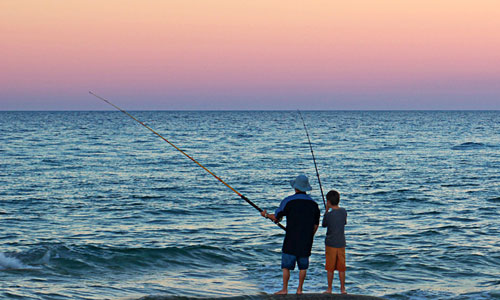
Fishing with a son is a great way to build positive relationships and great memories

The First Presidencies release of "A Family Proclamation to the World" http://www.lds.org/family/proclamation?lang=eng was an inspired response to this crisis.  President Gordon B. Hinckley was very direct in speaking to young men about the critical need to go and missions, attend post secondary schooling, and to not delay getting married and starting families.

How about a little B-Ball

Friday, February 17, 2012

Homes and Huts in Kiribati

Traditional I-Kiribati Homes and Huts


The photos that follow are a few examples of some of the traditional huts and homes.  Some  are just pieced together using corrugated metal roofing for walls or what ever is available.  Others are made of cinderblock or cement blocks, several families have chose to build western ranch style homes.


Framework for a Traditional home


Note how the Y shaped wooden support posts use to hold the horizontal poles in place
The roof trusses (diagonal are lashed together  to the horizontal limbs - using coconut string to lash the structure together.  The horizontal cross beams are also lashed in place to provide additional strength to the roof structure.  The poles will be trimmed (sawed off) before attaching the thatched roof on to the frame


The posts are made from wood from the trunk of coconut and pandanus trees and then lashed together with string made from the fibers of coconut husks.  The wall is made from the mid-ribs of coconut branches.  A home may have many windows but no glass in them but instead curtains woven from coconut leaves.  The blinds are used when it is rainy, very sunny, or windy.  The thatch on the roof is made from pandanus leaves.  Coral rocks are used for the floor and then covered with large mats woven from coconut and pandanus trees.


There are a variety of traditional homes some with two stories, raised floors, and no walls at all.  


Furniture, like chairs, tables or beds is rarely used by the I-Kiribati.  They sleep on the floor on mats woven from pandanus leaves.  They use kerosene lamps.  Some houses have concrete block walls with metal roofs.  There are rain gutters to collect drinking water when it rains.  But most of the time they use shallow wells to obtain water.


Cooking on a grill using copra (which is similar to charcoal briquettes are made from dried and crushed coconut shells

Note the hut in the background uses Coral rocks to support the horizontal beams
It has floor about 2 feet off the ground made by using small branches lashed together over support logs.  These huts are comfortable for sleeping with the breeze blowing above and below you

Manse hut


It often takes up to 150 pandanus branches to cover a roof
Comfortable home with a small patio
Often homes are built in clusters of three - one for general living, one for cooking, and one for storage.
A few traditional homes with one under construction in top left
(note how the thatch mats are beginning to be placed on the roof structure)
Small village with part of  a maneaba shown on the right side of photo
Village Maneaba at a resort site we visited in Bikeman Island (see post in December)
House on stilts
Several types of huts house used by an extended family 
Christmas Island - Thatched roof - pandanus mats also cover the lower walls for privacy
Traditional village


Most villages range in size from 10 to 120 dwelllings


Many huts are pieced together with what ever is available
such as corrugated steel that would normally be on a roof
Coconut or pandanus leaves are braided around mid-ribs to provide privacy


Most I-Kiribati don't worry much about privacy, they would rather have the breeze flow in the homes.This particular fence is at the Tiwanese' aquarium where they grow milk fish to feed the pigs and chickens