 |
| Bonriki International Airport |
 |
| Air Kiribati |
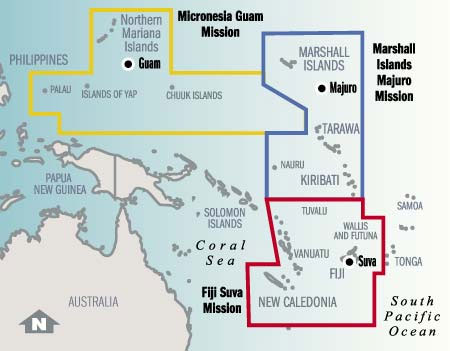 |
file://localhost/Users/brent/Desktop/MISSION%20MARSHALL%20ISLANDS/IMG%20Photos/ Majuro, Marshall Islands is in the top blue box about 300 miles from TarawaFiji is in the red box below Tarawa - So close but so far away!! |
Life in Kiribati
Estimates range from fifty to over eighty percent of the I-Kiribati families live from day to day on the subsistence agriculture and fishing. Large families are valued because help is required to feed the family such as deep sea fishing, net fishing along the shore lines, gathering shell fish, collecting coconuts, breadfruit, pandanus, native figs or the giant swamp taro grown in deep water pits. Women do the cooking, laundry and other household responsibilities, as well as childcare. Sometimes women help men work in the babai (a taro-like starchy root crop) pits. Only the men fish using small boats and outrigger canoes.
 |
| Wash Day (clothes are washed by hand in a tub) and hung to dry |
By tradition land inheritance is divided between a family's children, making family plots smaller each time it is divided. The government has encouraged smaller families and now many children have decided to share the land instead of further dividing it. The vital unit in I-Kiribati society, the "utu" includes all those people who are linked as kin and share common ownership of land plots. Everyone on the island belong to several utu; people may inherit the land rights for each utu from either parent. To reduce conflicts over land the government now requires all land transfers to be registered.
Food and Economy
Typical food may include grate coconut into tea. Coconut milk to sweeten breadfruit soup or adding curry powder to marinate raw fish. Coconut sap or toddy cut form the flower spathe, is rich in vitamin C is collected twice each day by boys who climb the trees (usually barefooted). Toddy is used as a children's drink or as a base for syrup. The sap is boiled over low heat and forms a sweet molasses called kamaimai, which is used to sweeten dishes or drinks in place of sugar or it can be soured into vinegar. Fermented toddy becomes an alcoholic drink known as kakioki.
 |
| Net fishing is common along the coast line |
The cash economy is limited to South Tarawa, where the private sector of the economy is very small with few manufacturing enterprises. To supplement their income, there are many small stores and shops next to nearly every large speed bump (and they are large), where a variety of goods are sold: including food, bananas, papaya, breadfruit, kamaimai, kakioki, crafts, woven baskets and mats, smoked fish, second hand clothing, pots and pans and many other commodities.
 |
| This Turtle with sea shell body and head and woven legs from native plants sells for around $5.00 |
 |
| People gather around to admire a large fish. Only men do the fishing using small boats and canoes |
 |
| Small Model of an outrigger boat sold at roadside stands |
 |
| Drawing Water from a Well for Cooking, Bathing, and Laundry |
 |
| Outdoor market selling bananas and other items Most I-Kirbati people are resourceful and live modestly. Take for example the coconut tree: part is used for cooking, making mats, midribs are lashed together with small ropes for building houses, sap from the tree is used for sweeteners and as it ferments for alcohol, the nut is dried and sold as copra (as a cooking fuel. Coconut oil is used to make soap and refined for body oil. The trunks of the trees make pillars to hold the roofs up on homes, maneabas and other structures and the prond leaves from the tree are woven to make the thatched roof on native huts.  Pandanus pronds and leaves are woven together to make the mats to sleep on. The mats also are used to hang on the open sides of the home to provide some privacy and are used to sit cross-legged on the coral rock floors. Woven mats are also sometimes layered as long shingles to make water proof roofs on some homes and for a village maneaba. Coconut pronds are also used for weaving mats, hats, tradition customs for dancing and other purposes |
 |
| Traditional home |
 |
| Another style of home in Kiribati, note the mats hanging for privacy |
 |
| Tarawa Car Port, not many people own automobiles |
The typical home has a thatched roof with stick walls supported by larger posts. The windows have no glass and are cut from sticks. The floor is coral rocks floor, covered with woven mats from usually a socializing buia (a raised platform) next to the house. There is usually a separate house for cooking. Water is drawn from a well or from the pipes where water is pumped, sometimes only once per week. All houses have a roki (bathroom), which is inside or next to the house. The roki will have a water-sealed pit latrine. Some huts are built from what ever is available it is not unusual to see corrugated tin normally used for roofs instead used for walls.
Few I-Kiribati have automobiles. On Tarawa the main mode of transportation are taxies or mini buses from one end of the island to the other for a fare that varies from 55 cents to $1.40 depending on the length of the ride. You see dozens of Toyota eight passenger vans one after another, picking up and letting off passengers. They drive very fast for conditions and vehicles and pedestrians need to stay alert. Many use motor scooters and bicycles for transportation.
When trucks slows down young men run and jump on the back of the truck for a free ride, until they get to another speed bump near their destination, they then jump off when the truck slows down. Usually they are barefooted when they jump off and hit the road, but walking around barefoot all their lives have toughened the souls of their feet almost like leather.
 |
| Traditional Maneaba |
I-Kirbati greet each other with Mauri ("blessings"). A more informal greeting is ko no era? ("where are you going"). To get someones attention, they may call out Neiko ("Woman") or Nao ("Man") even if the persons name is known. Handshakes are usually only for formal gatherings or sending someone off or when people haven't seen each other for some time. The traditional greeting is to nod their heads upward and say Mauri (mowdy). People address each other by their forename (first name) in informal situations. Even children call their parents by their forename. A persons last name is usually that of their father or grandfathers forename. In formal situations, the titles Nei ("Miss" or "Mrs.") and Ten ("Mr") are used before the forename to show respect. (information from pacificislandtravel.com)
Just about every social gathering is called a botaki. This could range from having a few friends over to play cards and/or eat to having a week-long island festival. More informal gatherings are often held in homes on the bula (porch). More formal botaki or celebrations are held in a maneaba (Mane means "to collect" and aba means "the land" or "people of the land"). The maneaba is the center of community life and their are strict traditions regarding their construction, seating arrangements, and member's duties. Some require a formal written invitation delivered a few days before the event.
People sit cross-legged on pandanus mats in a large circle. Bowls of food are passed around and spoons and fingers are used to eat. Traditionally men eat first, and women in children eat in a separate area after the men finish. It is good manners to eat all of the food on ones plate and considered a complement to the cook to get a second helping. People converse freely during family meals but in the maneaba people refrain from conversation until the dishes have been removed and everyone is relaxing.

Much of the traditions and social life (botaki) take place in a Maneaba located in each village
The older men and guests usually sit in front with the women and children sitting around the edge of the maneaba behind the men. Speeches are almost always given, some prayers are usually said, and large amounts of food are eaten. Songs are song by different groups of people. If there is electricity or a generator loud music may be played and people dance in the middle of maneaba.
Botakies are held for a variety of reasons, including 21st birthday, right of passage, engagement, weddings, anniversaries, people arriving on the island, and any holiday.The largest national holiday occurs in July to celebrate the nations independence from Britain is celebrated for a week. Other holidays include include: International Women's Day, Easter, National Youth Day, Human Rights Day, National Health Day, Christmas, Boxing Day, and New Year's.
In a future Post we will show the traditional material skills it take to construct a Maneaba
Botakies are held for a variety of reasons, including 21st birthday, right of passage, engagement, weddings, anniversaries, people arriving on the island, and any holiday.The largest national holiday occurs in July to celebrate the nations independence from Britain is celebrated for a week. Other holidays include include: International Women's Day, Easter, National Youth Day, Human Rights Day, National Health Day, Christmas, Boxing Day, and New Year's.
In a future Post we will show the traditional material skills it take to construct a Maneaba
