Wednesday, January 4, 2012

Random Photos of the Island

A few random Photos of Tarawa
This sign was only a few miles from our home - But has been recently removed
(9.84 feet is the highest point in South Tarawa - - only one Atoll of the 33 in Kiribati is above 4 meters)
Beach front property for those who don't walk in their sleep


Provides some shade for lunch, who needs a Beach Umbrella 


Posing for Camera


Seabirds over Kiribati


Found this photo on the internet of a storm moving to the islands


Sunrise, Sunset - Quickly goes the Days


Fisherman's Working Canoe


One road goes the length of the islands connected by causeways


 The island nation of I-Kiribati is made up of 32 atolls and Christmas Island (population estimated at 100,000)
 Geographically Kiribati is the size of the United States (5,000,000 square kilometers of ocean)
But, the total land mass is only 313 square miles (811 square km)


The length of the island chain is about 30 miles -
We live in Eita (Bottom right side of the "J" shaped atolls)
I-Kiribati Old Parliament Building
Beautiful New Parliament Building for I-Kiribati
Areo view of Kiribati's Parliament Building a few miles from Moroni High campus
Relocating a house or is it a mobile home?


It is not unusual to see over 20 people riding in the back of trucks
A crab about this size crawled out from under our office desks a few days ago.
We have no idea how it got in our office (but I guess, it is better than finding
one in our toilet, like some of the missionary couples have


Elder and Sister Pulsipher took this photo of a crab in their toilet 
They lived in  the apartment in which we currently reside.  
When we go in the bathroom at night we turn on the light to check things out first

Sunday, January 1, 2012

A New Year in Kiribati

Bonriki International Airport 
With a new year comes the reality of our isolation from much of the world.  Air Marshall's plane that flies to Kiribati, has again been grounded due to engine problems and will have to return to Hawaii for additional repairs.  This means the young elders and sisters still have not received their Christmas packages from their families at home.  To compound Presidents Shaw's problems, there are two elders being transferred to Christmas Island who are stranded in Fiji, because the plane that flies there was also having problems.  Air Pacific brought in a larger plane to replace it, but the pilot said he didn't feel comfortable flying the that large of an airplane to Christmas Island; so the flight was canceled leaving the two elders remain stranded.  Hopefully air traffic will soon be back on schedule in Fiji, but we are not sure when Air Marshall will resume flights to Tarawa.
Air Kiribati 
Air Pacific usually flies to Tarawa twice a week (Tuesday and Thursday) from Fiji.  Our (Air Marshall) Airlines also flies from Brisbane to Majuro and back twice a week, stopping in Tarawa once a week to pick up passengers on the way up and for the Solomon Islands and Brisbane on the way back.  Air Kiribati is the National airline and has at least one scheduled flight a week to each of the Gilbert Islands.  But with only one plane is is often down for service or unable to fly in bad weather.


file://localhost/Users/brent/Desktop/MISSION%20MARSHALL%20ISLANDS/IMG%20Photos/
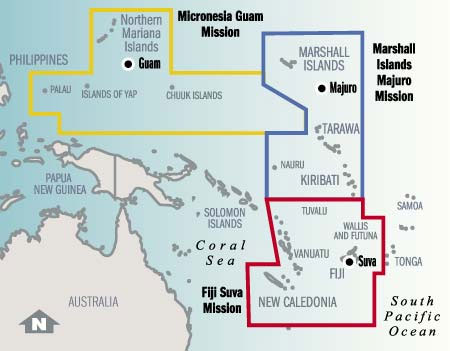
Majuro, Marshall Islands is in the top blue box about 300 miles from Tarawa
Fiji is in the red box below Tarawa - So close but so far away!!
Life in Kiribati

By world economic standards I-Kiribati would be considered a poor country, if the only measure was income, GNP and household material goods.  But it is very rich in its traditions and its people are remarkably self sufficient in using the plentiful natural resources to feed and shelter their families.  You do not see beggars or panhandlers asking for money so prevalent in many countries around the world.

Estimates range from fifty to over eighty percent of the I-Kiribati families live from day to day on the subsistence agriculture and fishing.  Large families are valued because help is required to feed the family such as deep sea fishing, net fishing along the shore lines, gathering shell fish, collecting coconuts, breadfruit, pandanus, native figs or the giant swamp taro grown in deep water pits.  Women do the cooking, laundry and other household responsibilities, as well as childcare. Sometimes women help   men work in the babai (a taro-like starchy root crop) pits.  Only the men fish using small boats and outrigger canoes.
Wash Day (clothes are washed by hand in a tub) and hung to dry
Older people are highly valued, honored and respected.  The 'old men' (council of elders) are the village leaders and its governing body.  If an individual is causing problems among their neighbors, the old men  counsel together and may give the offending person an ultimatum to change or they will have to move from the village.  If the required changes do not occur the offending person is given a specific timeline to move from the village, if he doesn't comply - his home is may set on fire.  Older people are loved, honored and cared for by their families.  There is no need for senior centers or old folk homes; as people age and become frail or in ill health, extended families care of them.

By tradition land inheritance is divided between a family's children, making family plots smaller each time it is divided.  The government has encouraged smaller families and now many children have decided to share the land instead of further dividing it.  The vital unit in I-Kiribati society, the "utu" includes all those people who are linked as kin and share common ownership of land plots.  Everyone on the island belong to several utu; people may inherit the land rights for each utu from either parent.  To reduce conflicts over land the government  now requires all land transfers to be registered.

Food and Economy
Typical food may include grate coconut into tea.  Coconut milk to sweeten breadfruit soup or adding curry powder to marinate raw fish.  Coconut sap or toddy cut form the flower spathe, is rich in vitamin C  is collected twice each day by boys who climb the trees (usually barefooted).  Toddy is used as a children's drink or as a base for syrup.  The sap is boiled over low heat and forms a sweet molasses called kamaimai, which is used to sweeten dishes or drinks in place of sugar or it can be soured into vinegar.  Fermented toddy becomes an alcoholic drink known as kakioki.

Net fishing is common along the coast line
Locally caught fish, breadfruit, pandanus, papaya, and babai are staples for most meals. Crayfish,  giant clams, pork, chicken are usually reserved for feasts.  The most symbolically valued crop is giant swamp taro, which is grown in pits dug into the water lens under each atoll.  Imported rice, flour, canned meats and fish are being used on an increased basis.  Most families do not have refrigerators so salt is used as a preservative.  Fish is also preserved by being dried in the sun.

The cash economy is limited to South Tarawa, where the private sector of the economy is very small with few manufacturing enterprises.  To supplement their income, there are many small stores and shops next to nearly every large speed bump (and they are large), where a variety of goods are sold: including food, bananas, papaya, breadfruit, kamaimai, kakioki, crafts, woven baskets and mats, smoked fish, second hand clothing, pots and pans and many other commodities.
This Turtle with sea shell body and head and woven legs
from native plants sells for around $5.00

People gather around to admire a large fish.  Only men do the fishing using small boats and canoes

Small Model of an outrigger boat sold at roadside stands

Drawing Water from a Well for Cooking, Bathing, and Laundry 

Outdoor market selling bananas and other items


Most I-Kirbati people are resourceful and live modestly.  Take for example the coconut tree: part is used for cooking, making mats, midribs are lashed together with small ropes for building houses, sap from the tree is used for sweeteners and as it ferments for alcohol, the nut is dried and sold as copra (as a cooking fuel.  Coconut oil is used to make soap and refined for body oil.  The trunks of the trees make pillars to hold the roofs up on homes, maneabas and other structures and the prond leaves from the tree are woven to make the thatched roof on native huts.

Pandanus pronds and leaves are woven together to make the mats to sleep on.  The mats also are used to hang on the open sides of the home to provide some privacy and are used to sit cross-legged on the coral rock floors.  Woven mats are also sometimes layered as long shingles to make water proof roofs on some homes and for a village maneaba.  Coconut pronds are also used for weaving mats, hats, tradition customs for dancing and other purposes
                       
Traditional home 
Another style of home in Kiribati, note the mats hanging for privacy

Tarawa Car Port, not many people own automobiles

The typical home has a thatched roof with stick walls supported by larger posts.  The windows have no glass and are cut from sticks.  The floor is coral rocks floor, covered with woven mats from usually a socializing buia (a raised platform) next to the house.  There is usually a separate house for cooking.  Water is drawn from a well or from the pipes where water is pumped, sometimes only once per week.  All houses have a roki (bathroom), which is inside or next to the house.  The roki will have a water-sealed pit latrine.  Some huts are built from what ever is available it is not unusual to see corrugated tin normally used for roofs instead used for walls.
                                                                                Few I-Kiribati have automobiles.  On Tarawa the main mode of transportation are taxies or mini buses from one end of the island to the other for a fare that varies from 55 cents to $1.40 depending on the length of the ride.  You see dozens of Toyota eight passenger vans one after another, picking up and letting off passengers.  They drive very fast for conditions and vehicles and pedestrians need to stay alert.  Many use motor scooters and bicycles for transportation.                                                                                                                    

When trucks slows down young men run and jump on the back of the truck for a free ride, until they get to another speed bump near their destination, they then jump off when the truck slows down.  Usually they are barefooted when they jump off and hit the road, but walking around barefoot all their lives have toughened the souls of their feet almost like leather.
Traditional Maneaba
Social Activities:
I-Kirbati greet each other with Mauri ("blessings").  A more informal greeting is ko no era? ("where are you going").  To get someones attention, they may call out Neiko ("Woman") or Nao ("Man") even if the persons name is known.  Handshakes are usually only for formal gatherings or sending someone off or when people haven't seen each other for some time.  The traditional greeting is to nod their heads upward and say Mauri (mowdy).  People address each other by their forename (first name) in informal situations.  Even children call their parents by their forename.  A persons last name is usually that of their father or grandfathers forename.  In formal situations, the titles Nei ("Miss" or "Mrs.") and Ten ("Mr") are used before the forename to show respect. (information from pacificislandtravel.com)

Just about every social gathering is called a botaki.  This could range from having a few friends over to play cards and/or eat to having a week-long island festival.  More informal gatherings are often held in homes on the bula (porch).  More formal botaki or celebrations are held in a maneaba (Mane means "to collect" and aba means "the land" or "people of the land").  The maneaba is the center of community life and their are strict traditions regarding their construction, seating arrangements, and member's duties.  Some require a formal written invitation delivered a few days before the event.

People sit cross-legged on pandanus mats in a large circle. Bowls of food are passed around and spoons and fingers are used to eat.  Traditionally men eat first, and women in children eat in a separate area after the men finish.  It is good manners to eat all of the food on ones plate and considered a complement to the cook to get a second helping.  People converse freely during family meals but in the maneaba people refrain from conversation until the dishes have been removed and everyone is relaxing.

Much of the traditions and social life (botaki) take place in a Maneaba located in each village
The older men and guests usually sit in front with the women and children sitting around the edge of the maneaba behind the men.  Speeches are almost always given, some prayers are usually said, and large amounts of food are eaten.  Songs are song by different groups of people.  If there is electricity or a generator loud music may be played and people dance in the middle of maneaba.

Botakies are held for a variety of reasons, including 21st birthday, right of passage, engagement, weddings, anniversaries, people arriving on the island, and any holiday.The largest national holiday occurs in July to celebrate the nations independence from Britain is celebrated for a week.  Other holidays include include: International Women's Day, Easter, National Youth Day, Human Rights Day, National Health Day, Christmas, Boxing Day, and New Year's.

In a future Post we will show the traditional material skills it take to construct a Maneaba

Tuesday, December 27, 2011

Christmas with the Missionaries

We Love Christmas Time

Christmas was very enjoyable, most of our time was spent serving the younger full-time missionaries.  On December 23rd we stuff a Christmas stocking for each missionary.  On Christmas Eve the missionary couples (Bonnemort, Ogborn, Thorne) cooked a Christmas Dinner for the missionaries. Turkey with all the  trimmings.  They all enjoyed a traditional Christmas meal. There was plenty of food to eat and it was all very good.

Following the dinner, they watched a movie that had a good message about "overcoming the giants".  Can't remember the exact title.  Following the movie, the stockings and Christmas mail was handed out.  Unfortunately their packages from home did not arrive, due to the airline problems - but they appeared to really enjoy receiving a Christmas stockings.
Hungry Missionaries waiting for Christmas Dinner
Christmas Stockings for each missionary
Christmas fell on Sunday so following Church, about half the missionaries were able to use the senior couples SKYPE connection to call home.  The remainder of them called home on Monday, which was Christmas Day in the United States.  Eventually all of them were able to enjoy an hour visiting with loved ones at home.

We were able to call our families the day after Christmas to see what the grandkids got from Santa.  That is always special even if we are 6000 miles from home.  We have one more call to make to North Dakota when they return from Jackson Hole in a few days.

On December 23rd in Richfield, Utah they honored our National Guard Unit who all have arrived safely from their second tour of duty in Iraq.  For the past six years we have made small chairs honoring each soldier that serves in a combat area.  It is called the Freedom Chair Project.  Before we left we turned and assembled nearly 150 chairs for the soldiers.  Local businesses, government agencies, civic groups, and individuals donate money to sponsor one or more chairs.  This year we raised over $16,000 for the Family Readiness Group in Sevier County (the funds are used to help meet the needs of the soldiers families while they are deployed.  General Patrick Wilson sent me some photos of the event.

 Preparing for Banquet to honor 222nd National Guard Unit just returned from Iraq 
'Freedom Chairs and Gift Baskets presented to each Soldier
A supper was provided for the soldiers and their families along with a freedom chair and a large food basket for Christmas at the banquet.  This is a small token to thank them for defending our freedom through out the world.  The project started out as a simple idea to raise some funds to help and honor our brave soldiers, but during the past 6 years over 500 chairs have been handmade and presented to soldiers from Sevier County serving in combat areas.  Through the generous donations over $50,000 has been raised for military families.  The chairs take about 6 hours to turn, sand, stain, assemble and polish.  All chairs are made from hardwoods: Ash, Cherry, Maple, Oak, and Walnut.  A small plaque is placed under the seat of each chair with the soldiers name, rank, and a thank you for their service.
Overhead Photo of the 132 Freedom Chairs presented to Sevier County soldiers in December 2005.
 Over 100 chairs were presented to the 222nd in 2011

Tuesday, December 20, 2011

Christmas in Kiribati

Enjoying Christmas surrounded by the sea - on the Equator
in what perhaps, will be our Warmest Christmas Greeting Ever!
Christmas is just around the corner - only 3 more days to be exact.  Being on the international date line, Kiribati will be the first country in the world to have Christmas Day - - the rest of you will have to wait for 24 more hours (Naa Naa Naa).  That means Santa will land here first!   
Rudolph and the other reindeer will have to use water wings on their legs to land in Kiribati
Unfortunately we have no chimney for him to crawl down.  No snow on the roof where the reindeer can land.  No problem, Santa's sleigh will use pontoons, which the elves will attach so he can land in Kiribati to deliver presents to the boys and girls here and other places on the isles of the sea. We expect him to land on the ocean right behind our house, and then roll up his pant legs and wade through the shallow water to our back porch.  We will keep the backdoor unlocked - please don't tell the neighborhood burglars.  We will leave some breadfruit cookies and glasses of coconut milk for him, his elves and of course the reindeer. 
                                  After watching his video, maybe we should skip the cookies?
If I was Santa, I would stay in the sleigh and have the elves deliver the presents.  Santa needs to stay dry, so his beard doesn't freeze or have his sleigh 'ice up' at high altitudes, before he gets to where it is really cold such as in Utah and North Dakota.  After all we need him to deliver some really nice presents to some very cute grandkids.
Santa's Sleigh with Pontoons - making Deliveries to Kiribati   
Comparing a Kiribati Christmas on the Equator
To that of an Eskimo Village in Alaska  
There isn't a lot of evidence around here - that Christmas is nearly here, at least not like in the United States and other more developed countries;  where Chistmas is so often - overly commercialized.  We see a few decorated artificial trees in a some stores and an occasional manikin in a Santa outfit that look rather bizzare.  
Santa must have found the "fountain of Youth" in Kiribat                                                 
There are few lights on some of the huts and stores but not many. In some ways it is refreshing and in other ways we do miss some of fun the traditions - such as buying things for and spoiling our grandkids.  So far we haven't even sung a Christmas hymn in Church, that we really miss!!
Sister Thorne's 33 inch Christmas Tree
                                                                                                   
Sister Thorne has again put her creative talents together to make a cute little Christmas Tree that is held to the wall using thread hanging from a couple of nails in the wall and some duck tape.  


Air Marshall (or Scare Marshall) as some refer to it) is how the packages are delivered from the mission home in the Marshall Islands and then shipped via air freight to Tarawa. Unfortunately the only airplane that flies from the Marshall Islands to Tarawa had its engine replaced.  Thus, there have been no flights flights from there for over a month.  The mail and packages have been piling up in the mission home.  There have been no boats or ships that have traveled between the two island groups during the past month eithr. But, alas there still may be hope for a Christmas delivery.


There is a flight from there scheduled to be in Tarawa this afternoon, but because it is fully booked.  The 500 pounds of packages for the younger missionaries from their families and loved ones have been delivered to the airport, hopefully will arrive later today.  But with the flight fully booked with the passengers and their luggage, a high probability exists that the packages will get bumped.  Christmas away from home for these young elders and sisters is tough enough with out packages from home.  Letters and goodies from home really brighten their day, especially at Christmas time.   The mission home staff didn't even attempt to ship any packages for the senior missionary couples, which is Ok by us.  They  will arrive eventually, hopefully before Easter or at   least by the 4th of July or perhaps Labor Day or Thanksgiving. 
We couldn't get the Coconut or Palm Trees through our front door
The missionaries will call home on Christmas day - where their families live, not our time. The senior couples SKYPE connections will be used for the missionaries with a one hour time limit for each.  Hopefully, their families will also have SKYPE so they can see each other.  The missionaries from the Pacific area will be calling home on Sunday(our time) and those in the States will be calling on Monday.  We hope to work in some time for a call to each of our families at home.  Brian, Tracy and kids will be in Arizona with her parents,  Brian, Jalene and kids will be at Jackson Hole, Wyoming, and Keven, Carrie and their three will be in Richfield, Utah. 
On Saturday - December 24th the senior couples will again provide a Christmas dinner for the missionaries.  There will be turkey, ham, dressing, potatoes and gravy, cranberry, rolls - the whole works.  Sister Thorne will also be preparing a fruit custard dessert from a secret Kiribati receipt (hopefully we will soon get the secret receipt so we know what to buy).  Thank you President and Sister Shaw for sending the Turkey and other goodies from destinations unknown.
On a More Serious Note: Christmas in Kiribati
Our Stake President Iouta Tune, spoke last Sunday in church about how they celebrated Christmas when he was growing up in Kuria, a small outer island on the equator South of Tarawa.  He said the day before Christmas, he and his grandparents walked quite some distance through the bush to the nearest village.  They slept on mats on the floor of  the Maneaba (the traditional gathering place in each village).  They joined most other residents of the area, who also slept there Christmas Eve.  The parents put a package for each child on a tree placed in the maneaba.  At midnight the local minister would call out each child's name and give them the package that their parents or grandparents had prepared.  Then on Sunday the family would attend church services.
The following is what a tourist brochure says - happens in Kiribati during the Christmas celebration. We will wait and see if it is really true or just marketing by a travel agency.
The Christmas in Kiribati is celebrated to commemorate the birthday of Lord Jesus as is done all across the world. Everyone rejoices to mark this special day which is basically a day of prime importance for the Christians. Christmas celebrations in Kiribati are one of the major events especially for the 2 major Christian Denomination Churches- Protestants and the Catholics. 
All the people even though they are not Christian get together to celebrate this festival in Kiribati as it becomes a meeting ground for all the cultures and traditions around the world. The celebration for Christmas in Kiribati usually begins on the Sunday when everyone attends the Christmas Service which is of great significance for everyone and especially for the Christians. The service at the church is followed by feasting and host of activities which are a favorite of the young and old alike. The main activities in Kiribati include local dancing, canoe racing, choir, sporting events like basketball, tennis, volleyball, soccer, boxing and game fishing.
Everyone enjoys the celebration mood till the New Year when people go in for picnics and excursion to the nearby islands and enjoy their holidays. The residents of Tarawa prefer to camp out in the Taiwan Park for about a week and here they have their barbecue feasts and entertaining activities every day until the New Year celebrations end. Be sure to visit Kiribati during Christmas for having a glimpse of the lifestyle of the islanders.
Our Christmas will be a time of gratitude for all the wonderful blessings we have received, for our great family, for the opportunity of serving among the wonderful people of the islands.  But most of all we will reflect on the birth, life, and atonement of our Savior, even Jesus Christ.
                                                   
                                          Video on why we have Christmas, that is often forgot
As the young Moroni High School students fervently declare, as they bare their testimonies, during talks and other church meetings; many of them express words to this effect: "My dearest brothers and sisters I know that Heavenly Father lives and loves each of us". Then they often sincerely express their love for their families and for each other.  Often they testify of the Divinity of His Son Jesus Christ, our Lord and Savior. Almost all conclude their testimony with a great conviction that: "The Church is very True". 
Sister Thorne and I also testify that Jesus is the Christ, the Son of our loving Father in Heaven.  We testify that our Savior died on the cross that we may all be resurrected. That in the Garden of Gethsemane, our Savior took upon himself all the sins of mankind. Through His atonement each of us may have our sins forgiven and removed, on the condition that we truly repent and forsake our sins. We must also keep His commandments including loving and serving one other.   
God the Father and His Son Jesus Christ live and they know each of us personally and their  greatest desire is to have each of us return to their presence. The Father and His Son loves and blesses each of us in our daily lives, whether we recognize it or not. 
That is why we commemorate His birth at this special time of the year, may you also gain a firm knowledge and conviction of this truth is our humble prayer. In the name of His son Jesus Christ, Amen.
May the Lords choicest blessings be with each of you during this special time of the year.   
"Ask for His presence instead of Presents"
Wishing you each a very Merry Christmas!
Elder and Sister Thorne

Friday, December 9, 2011

School Christmas Social

We attended a Christmas Party on Monday afternoon with teachers and Church employees in the cafeteria.  Again there was lots of food.  We were divided into 4 groups and each group sang 2 Christmas hymns each. (Senior Couples, Teachers, Support Staff, Service Center Employees).  
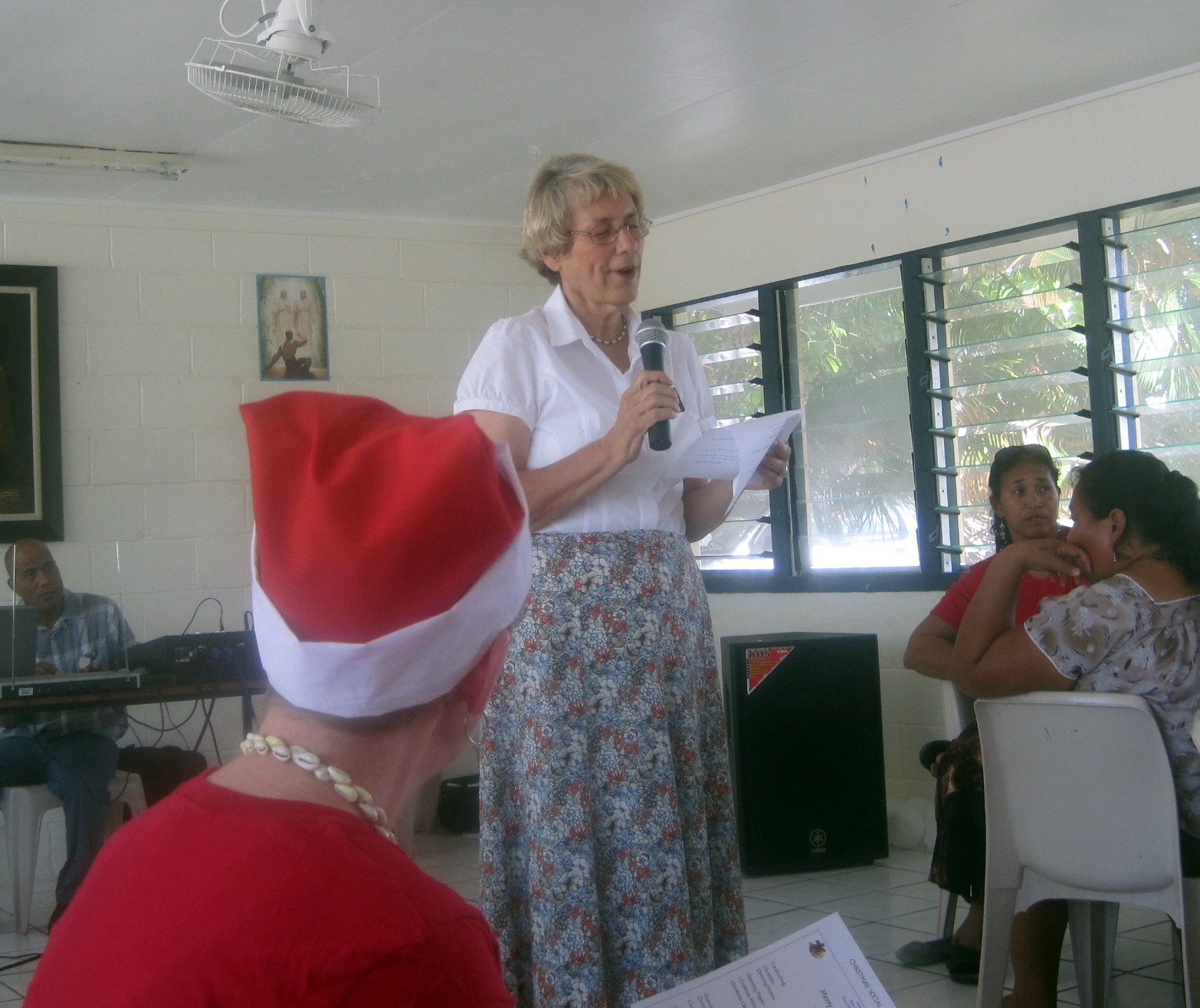
Sister Thorne giving Christmas message


Sister Thorne and I were asked to give a Christmas message a few hours before the program.  Fortunately Lita had saw the minutes of the planning meeting and warned us a few days in advance that we were speaking. 
Pres. Tune giving remarks and thanking the employees
Administration and Office Staff singing Christmas Carols
Some of Moroni High Teachers harmonizing with Sister Boutara IOTEBWA as the lead singer 
Next we ate a large variety of Kiribati dishes.  The food we tried was all good, some I have been hesitant to try.  The Senior Couples then did a lip sync to the song by the Drifters, “I Dreaming of a White Christmas”.  Sister Ogborn made Santa hats for each of us.  It was a lot of fun as we took turns hold a fake microphone and acting like it was us singing.  Sister Thorne really got into it and surprised many of the teachers who thought she was always very serious and dignified.  Several commented how much they enjoyed her performing.  The rest of the groups were supposed to perform, but didn’t.  So I guess we one first place in the competition (also last place)
Service Center employees singing two carols


The employees love to sing.  Before the party began music was being played and there were always three or four who took the microphones and sang along with the music.  They are very good singers and love to harmonize, when the speakers are set up, you will see them singing for hours along with the music.  It is a joy to watch and hear them having so much fun and sharing their talents with others.  


Senior Couples (Elder and Sister Ogborn, Elder and Sister Bonnemort, and Elder and Sister Thorne) in their Santa Hats getting ready to finish off the evening with a glass of ice cream.  It isn't  as good as Utah State 'Aggie' Ice Cream but it is cold and hits the spot on hot days at the equator.

Friday, December 2, 2011

Leadership Retreat on Biketawa Island

Moroni High School Leadership Retreat
On November 30th through December 2nd, we attended a leadership retreat at Moroni High School.  The Department heads, administration,  secretaries, librarian, head cook, and school nurse were invited.  The first exercise was to divide into groups and complete a SWOT (Successes, Weaknesses, Opportunities, and Threats) analysis of each department.  Sister Thorne and I reviewed the ITEP program, since we arrived. We then used the analysis to set ITEP  goals for the 2012 school year. There were several other excellent training sessions.
Church boat which took us to Biketawa Island
Thursday afternoon we traveled to a government resort site (similar to a state park in the USA) which was on Biketawa Island.  Approximately 20 participants and their spouses were attended.  We traveled on the Church boat from Bairiki near Betio to for approximately two hours to the island.   With all the equipment and supplies only12 people, including Sister Thorne and myself, were on the first boat trip.  
The Church boat is about 30 feet long and has two 90 horsepower Yamaha Motors.  It is used by the Church Service Center to travel to the outer islands to take supplies, and people who have business there.  The trip to Biketawa was a bit choppy with some large waves so with all the weight in the boat, three men moved to the hull of the boat and everyone else moved forward as much as possible.  
When we arrived it was dark, and with no light from the moon the boat pilot had a difficult time finding the deeper channels through the sandbars to approach the resort's coast line.  By the time we arrived it was also low tide, so the propellers were hitting sand and had to raised out of the water.  The men and some of women got off the boat about one-half mile from shore and pulled and pushed the boat until we were about 50 yards from shore.  From there we waded through knee deep water to carry all the supplies and personal gear to the camp site.  It took several trips to get the supplies from the boat.  The boat later returned to get the rest of the group, who met it at the Kiribati Parliament building, so their trip was much faster than ours.
Map of Tarawa Atolls (Bairiki bottom left and Biketawa
is about in the center of the map 


Biketawa is one of 24 small atolls and islets that make up Tarawa.  The boat was launced at Bairiki, which is near Betio (see bottom left of the map).  
We arrived in the dark so we had to put up our mosquito netting up in a Tepius (not sure of the spelling) which is a small hut with a raised floor about 4 feet off the ground and its dimensions are approximately 8 feet long and 6 feet wide.  It has a sloped roof made from pandanus leaves that are woven together and placed in layers - similar to shingles.  The woven pandanus mats are the length of the roof.  The floor of the hut has small branches laid side by side attached to larger branches going in opposite direction.  We put up the mosquito net tent and placed woven mats and small pads on the floor for our bed.  It wasn't exactly like our mattress at home, but we slept well and enjoyed the fresh breeze that blew over and under us for most of the night.
We slept in mosquito netting on woven mats in a Tepius (sic) hut
Maneaba where all the meetings and meals were held
The meetings and meals were held in the maneaba.  It was constructed out of native logs from coconut and other trees.  Many of the pillars and cross beams are held in pace by small ropes lashing the logs and branches together to form beams and the roof structure.  The roof covering is made from pandanus leaves.  When the leaves begin to turn brown they are removed from the tree and soaked in the ocean water.  The village women then weave them into long mat similar to shingles which are approximately 4 feet in width and the length of the structure.  The mats are then placed in layers similar to shingles on a roof for the length of the Maneaba.   
It makes a water tight roof that slopes to the approximately 4 feet from the ground.
Getting breakfast ready in the Meneaba
We ate all our meals in the Maneaba on large mats and a large table clothe placed in the center.  Every person sits on the mats cross legged as they eat the meal which is served family style.  Again the food was plentiful, it included roast beef, sausage, raw and cooked fish, rice, breakfast crackers, mixed vegetables and many other Kiribati dishes.  The secretaries and other support staff did most of the cooking.  
Janis spent a lot of time gathering sea shells for the grandchildren and got a good variety, even though a few of them started to crawl away.  She finally stopped looking along the shore beaches and waded in the narrow water and found many beautiful and unique shells for her collection.  
Gathering seashells by the sea shore
A new freshly woven hat by Bwereia for Sister Thorne       
Bwereia, one of the secretaries at Moroni High sat down on the ground and weaving a basket with long and narrow pandanus leaves.  She then wove Sister Thorne the hat shown on the photo at the left.  She also wove another hat, all in matter of a few hours.  Bwereia met her husband when they both were working for the  police department in Kiribati.  He still is a policeman, with the rank of Lieutenant.  He went to Moroni High and has served as a Bishop and other church callings.  Bweria quit her job with the police force to work for much less money at Moroni High.  It was interesting to visit with many of the spouses of the teachers and church employees who were at the retreat with us.  The dorm father joined us latter on Friday. He and a group of Moroni students walked and waded for about 4 hours to get to Biketawa.  They had lunch at his families home in the village and later walked back to South Tarawa before returning home. Meaua, (one of our FHE students walked with the group).                                                                                          
Government resort on Biketawa Island (similar to a state park in the USA
Small islet to the West and across the bay, it has a small village and a private resort
For the return trip we traveled to Bonriki - South West of the airport, it was approximately an hour boat ride.  After unloading the boat, we waited for the church van and truck to pick up our supplies and our group to return us to the Moroni Campus.  The boat then returned to get the rest of the group. 
It was a great three days of training and fun activities.  We were all especially proud of Sister Thorne for surviving over 3 hours, round trip, on the boat.  She does not like to be on, in, or fly over large bodies of water. But overall, she really enjoyed roughing it.  Despite some inconveniences like no running water in the restrooms; having to take a bucket of water to flush the toilets; and showering by dumping a bucket of water over your head and rinsing your hair with another bucket of water.  The pump that normally provides stored rain water for the restrooms was not working. 
The boat returned to get the rest of the group and on the way back it ran out of gas.  As all the ladies sang and danced on the boat some of the men were trying to find gas to put in the motors.  So the boat drifted and the ladies sang and had a good time.  Finally they got one of the motors started, so their travel was very slow.  They eventually got home about 11:00 p.m.  We are glad we were on the first boat trip instead of the drifting adventure.
It was good to get away from the crowded conditions on South Tarawa and get a feel of island life where only a few people live and to experience island life at a much simpler pace.  Lita and the administration did a great job of putting on an excellent professional development activity.